





Here’s the revised closing of the intro plus the featured snippet callout, all in WordPress-ready HTML:
htmlSince unhappiness comes from beliefs we learn and perpetuate, isn’t it logical that we can become happier by challenging and changing those beliefs? And couldn’t you become happier by simply choosing happiness?

  • Happiness is a state of mind — not a circumstance.
  • Happiness is an option available to you right now, regardless of what you’re facing.
  • Choosing happiness is an act of courage, not denial.

Now, I realize that’s easier said than done, especially when you’re stuck deep in a season of unhappiness. Moving from a place of anxiety, grief, or chronic pain to genuine happiness takes commitment, courage, and the right strategies. The six strategies below are what have worked for me — and I think they can work for you too.

What does it mean to create your own happiness?

Creating your own happiness means taking deliberate, intentional steps to cultivate positive emotions and mindset — rather than waiting for your circumstances to change first. It’s the practice of choosing a happiness-oriented focus even when life has given you real reasons to feel otherwise. And it’s a skill anyone can learn, including those of us living with chronic illness, grief, or hardship.

Key Takeaways

  • Learning how to create happiness when life is hard is a skill — one anyone can develop with practice.
  • Happiness is not a result of circumstances. It stems from your beliefs and where you direct your focus.
  • Choosing happiness is not toxic positivity — it is a courageous, deliberate act.
  • Gratitude journaling is one of the simplest and most effective tools for shifting your emotional baseline.
  • Your body can lead your mind — smiling and laughing release endorphins even when you don’t feel like it.
  • Fond memories are an available emotional reset tool, anytime and anywhere.
  • Taking ownership of your happiness means creating more of the moments that bring you joy — deliberately.
  • Self-pity acknowledges the hard thing. Happiness asks what you can do alongside it.
  • Chronic illness, grief, and hardship do not disqualify you from happiness. They just require more intention.
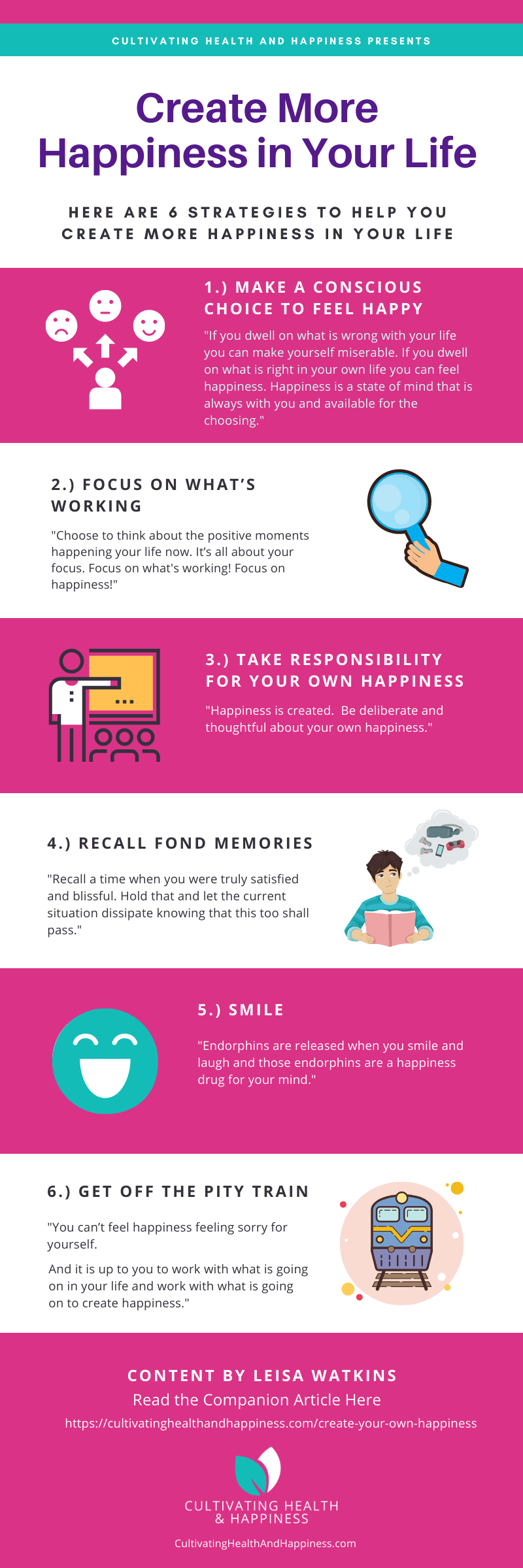
Infographic with 6 Strategies to Create More Happiness

Strategies to Help You Create More Happiness in Your Life

These aren’t quick fixes or toxic positivity. They are deliberate practices — the ones that have genuinely worked for me through diagnosis, trauma, and the kinds of seasons that test everything you believe about yourself. Research from the Greater Good Science Center at UC Berkeley confirms that happiness is far less about circumstances than most people believe — and far more about intentional daily practice. That’s good news for all of us.

Strategy 1: Make a Conscious Choice to Feel Happy

My mom always said, “Anyone can think their way into depression.” She’s right. If you dwell on what is wrong with your life you can make yourself miserable. If you dwell on what is right, you can feel happiness. Happiness is a choice, and that choice is available to you at any moment — even when you’re in pain, even when you’re exhausted, even when the diagnosis is real and the hard thing really happened.

This isn’t about denial. It’s about where you direct your attention. Our brains are wired to scan for threat and problem — it kept our ancestors alive. But that same wiring, left unchecked, keeps us locked in a loop of what’s wrong, what’s missing, and what’s been lost. Choosing happiness means consciously interrupting that loop.

When faced with negative thoughts, turn them around. You can tell yourself something like this:

“Even though I have [this hard thing], I choose to be happy.”

It might look like this: “Even though I am separated from my children, I choose to be happy. I choose to focus on all the fun times we had together.” Then actually think about those times. Feel them. Let them be real in this moment.

Focus on moments when you felt blissfully happy. Recall those memories, feel them, remember how you felt — and let yourself feel it again right now. Remembering Easter morning egg hunts with my young children can instantly put a smile on my face. Recalling the breathtaking views our family experienced at Zion National Park brings me instant happiness and feelings of awe. Happiness is a state of mind that is always with you and always available for the choosing.

Try This Today

Write down one thing you are choosing to be happy about right now — not because your circumstances are perfect, but because you are choosing to direct your attention there. Keep it somewhere you will see it today.

Strategy 2: Shift Your Focus to What Is Working

When I think about the dark times in my life, I instantly feel the weight of them. So I choose differently. I choose to think about the positive moments happening in my life right now. It really is all about focus.

You know the phrase, “I’ll be happy when…”? People who live by that belief find that happiness always stays just out of reach. The Mayo Clinic notes that postponing joy while waiting for life to be less busy or less hard is one of the most common barriers to genuine happiness. Try changing it to: “I am happy now.” Look for evidence of what is already working in your life. It might sound like this:

  • “I am so happy I have a car to drive to work in. There are plenty of people who don’t.”
  • “I am so happy I get to walk to work. I see the sunrise. I get exercise. I notice things people in a hurry miss.”
  • “I am so happy I have options to choose from this morning — food in my kitchen, clothes in my closet, a day ahead of me.”

One tool that makes this shift easier is a gratitude journal. Use it daily. List three things you are grateful for. You’ll soon see evidence stacking up for why happiness is not only possible but already present in your life. Look for things to be grateful for even in difficult changes — a job loss can become an opportunity to start fresh, a repair can become an improvement. The reframe is always available to you.

This is especially important for those of us living with chronic illness. When your body is unpredictable, it’s easy to fixate on what it can no longer do. I’ve learned to look instead for what it did do today — even if that’s simply keeping me here. That counts. If you want to explore this more deeply, my article on what it’s like to live with autoimmune disease talks honestly about finding gratitude in the smallest of moments when your body feels like it’s working against you.

Try This Today

Start a gratitude journal if you don’t already have one. Tonight before bed, write down three specific things that worked in your favor today — no matter how small. Do it again tomorrow. Keep going for two weeks and notice what shifts.

One of the most powerful ways I’ve found to take ownership of my own happiness is learning to treat myself with the same kindness I’d offer a good friend. Start by identifying the things that genuinely feed your spirit — if you need help with that, my article on nurturing your spirit with things you love is a good place to begin. If you struggle with self-kindness — and many of us do, especially those of us who’ve spent years in survival mode — my article on what it means to be a friend to yourself is a natural next step. And if your inner critic runs loud, writing yourself a self-compassion letter is a surprisingly powerful practice for quieting it.

Strategy 4: Use Fond Memories as an Emotional Reset

Recalling a fond memory in a dark or angry moment is one of the most underrated happiness tools there is. When you’ve been sitting in a difficult emotion for too long, don’t push through it — step away from it. Remove yourself from the space you’re in. Go for a walk. Sit quietly somewhere and let your mind clear.

Then recall a time when you felt truly satisfied and at peace. Hold that feeling. Let the current situation begin to loosen its grip, knowing that this too shall pass. It always does.

Solitude plays a powerful role here. Before you can access a fond memory as a reset, you first need a quiet enough mind to receive it. If you find that difficult — if the noise of chronic illness, stress, or grief drowns out everything else — I’d encourage you to read about the five benefits of solitude and how even a few minutes of intentional quiet can change the emotional temperature of your entire day.

This strategy works best as a practice, not just a crisis tool. The more you build the habit of recalling happy memories in ordinary moments, the more quickly your brain learns to access them when you really need them.

Try This Today

Close your eyes and bring to mind one memory that makes you genuinely smile — a place, a person, a moment. Sit with it for two full minutes. Notice how your body responds. That shift is real, and you can access it anytime.

Strategy 5: Let Your Body Lead — Smile and Laugh on Purpose

This one sounds almost too simple, but the research backs it up. When you smile and laugh, your brain releases endorphins — your body’s natural feel-good chemicals — and those endorphins shift your mood whether or not you felt like smiling in the first place. The facial feedback hypothesis, supported by decades of psychological research, suggests that the physical act of smiling can actually signal your brain to generate more positive emotion. Your body doesn’t always wait for permission from your mind.

This is especially worth remembering on the days when chronic pain or fatigue has flattened your emotional range. Play and laughter are not luxuries for people living with chronic illness — they are tools. They lower cortisol, release endorphins, and interrupt the stress cycle that so often makes symptoms worse. Even a few minutes can shift something.

So go ahead — put on that movie, watch the funny videos, call the friend who always makes you laugh. Have a real belly laugh. Smile even when you don’t feel like it. It will do your body and your mind genuine good.

Try This Today

Find something that makes you laugh today and give yourself full permission to enjoy it without guilt. A funny video, a silly memory, a ridiculous meme — whatever works. Then notice how you feel after. That’s not wasted time. That’s medicine.

Strategy 6: Release Self-Pity and Reclaim Your Power

Self-pity is comfortable because it puts the blame for your unhappiness on external forces — and that feels like relief. It justifies not taking action when action would be hard, uncertain, or scary. But the truth is, you cannot feel genuine happiness from inside a pity spiral. And I say this as someone who has had plenty of legitimate reasons to feel sorry for herself.

The distinction I’ve had to learn — and keep relearning — is this: acknowledging that your circumstances are genuinely hard is not self-pity. Grief is not self-pity. Exhaustion is not self-pity. Self-pity is the decision to stop there. To make the hard thing the whole story. To use it as a reason not to try.

Getting rid of self-pity doesn’t mean pretending your life isn’t hard. It means deciding to work with what you’ve been given rather than against it. Stop measuring your life against what others have. Instead, look for the smallest things in the everyday — a flower coming up in the yard, running water, your dog losing its mind with joy when you walk in the door. Anything that makes you smile is worth your attention, because a little happy goes a very long way.

If you find that self-pity has become a well-worn groove — one that’s hard to step out of even when you want to — it may be worth exploring whether grief, trauma, or chronic illness has made it harder to access your own resilience. That’s not a character flaw. It’s a signal worth paying attention to.

Try This Today

The next time you catch yourself in a self-pity loop, try this: name what is genuinely hard without judgment. Then ask yourself one question — “What is one small thing I can do or notice right now that is good?” You don’t have to fix everything. Just find the one thing.

You Can Create Happiness — Even Now

Living with chronic illness, grief, or hardship doesn’t disqualify you from happiness. It just means you have to be more intentional about it than most. These six strategies aren’t about pretending life isn’t hard — they’re about choosing where you direct your energy and attention even when hard is your reality. Start with one. Practice it today. A little happy really does go a long way.

If this resonated with you, there’s more where it came from. I’ve put together an entire section of the site dedicated to cultivating happiness with chronic illness — gratitude practices, finding purpose, nurturing your spirit, and building the kind of joy that holds up even in the hardest seasons. Come explore it when you’re ready.

What are you going to do today to create more happiness in your life? Share in the comments below — I’d love to hear from you.

Frequently Asked Questions About Creating Happiness

Can you really choose to be happy?
Yes — not in a toxic-positivity way that dismisses real pain, but in the sense that you can consciously choose where you direct your focus and energy. Research in positive psychology supports that intentional practices like gratitude and mindfulness genuinely shift your emotional baseline over time. It takes practice, but it is absolutely something you can learn.
How do you create happiness when you're living with chronic illness or trauma?

Start small. Happiness doesn’t require your circumstances to change first. It requires redirecting your attention — to what is working, to memories that carry warmth, to the smallest moments of beauty in an ordinary day. These aren’t denials of your pain. They are anchors you can hold alongside it. The strategies in this article are ones that have worked for me through MS, trauma, and seasons that tested everything I had.

What are simple daily habits that create more happiness?

Gratitude journaling, recalling a fond memory when you’re struggling, doing one thing each day that brings you joy, smiling intentionally even when you don’t feel like it, and releasing the story that happiness isn’t available to you — these are the core practices covered in this article. None of them require perfect circumstances. All of them are available to you today.

Is happiness really a choice?
Happiness is less of a single choice and more of a daily practice — a series of small decisions about where you place your focus, what you tell yourself about your life, and how deliberately you create moments of joy. It isn’t about ignoring pain. It’s about refusing to let pain be the only thing you see.

About the Author

Leisa Watkins

Leisa Watkins is the founder of Cultivate An Exceptional Life and a lifestyle blogger who writes from her firsthand experience living with multiple chronic illnesses, including Multiple Sclerosis (MS), fibromyalgia, Lyme disease, and chronic fatigue syndrome/myalgic encephalomyelitis (CFS/ME).

Leisa is also a mother of children living with chronic illness. Some of their conditions overlap with her own, while others are different—illnesses she has spent countless hours researching in order to advocate for and support her family. This unique combination of personal and caregiver experience allows her to approach chronic illness with both compassion and well-informed insight.

Her mission is to empower others facing similar struggles to discover resilience, joy, and purpose—even in the midst of overwhelming circumstances. Through her blog and nstagram channel, Leisa shares personal stories, symptom-management strategies, and compassionate guidance rooted in lived experience and years of hands-on research.

She believes that while MS, trauma, and other hardships may reshape your path, they don’t erase the possibility of living fully. Join Leisa as she offers encouragement, practical tools, and hope-filled resources to help you thrive—no matter your diagnosis or circumstance.